Identify a center and build a cross
Choose the lowest center and connect four edges whose height and width match the neighboring centers.
Solve a Mirror Cube with the 3×3 method by reading piece height and shape instead of sticker colors.
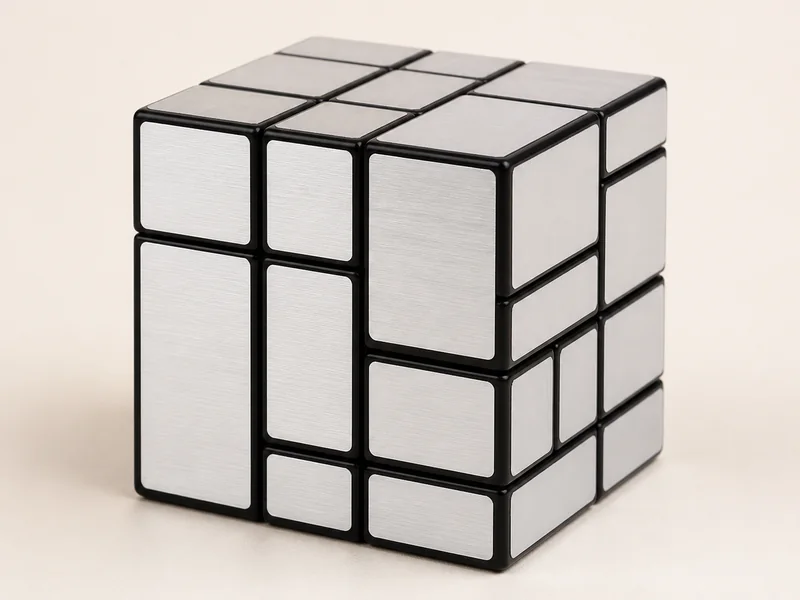
At every step, replace “which color belongs here?” with “which piece creates a flat surface here?”
Choose the lowest center and connect four edges whose height and width match the neighboring centers.
Insert the four corners so every side of the layer forms a continuous, flat surface.
R U R′ U′Match each edge by length and thickness, then insert it right or left as on a 3×3.
U R U′ R′ U′ F′ U FAlgorithmU′ L′ U L U F U′ F′Use the familiar 3×3 sequences for the cross and corner orientation, following height rather than color.
F R U R′ U′ F′Place the remaining corners and edges until all six faces are flat and the cube returns to its original shape.
A mirror cube has the same basic piece layout as a 3×3. The pieces have different dimensions, so a solved face is identified by a flat surface and matching side heights. One flat face is not enough: the whole first layer must line up around all four sides.
If an algorithm seems to scramble a solved layer temporarily, finish the full sequence with the same grip before judging the result. Never force a turn when a protruding piece blocks the layer.
Review the 3×3 beginner method and face-turn notation. Once you can solve consistently, use the online cube timer to measure progress.
A flat face is only the first check. Rotate the whole puzzle and inspect the four sides around that face: the first-layer pieces must form a continuous band with matching dimensions.
Use the 3×3 beginner guide for the layer goals and the move notation reference for turn directions. Return to the current layer’s checkpoint before trying to solve the next one.